
Choosing Timber for Bespoke Joinery: Why Veneer, Grain and Material Selection Matter
Timber is wonderfully inconsistent.
Two boards cut from the same species can look completely different. Two veneer leaves from the same log can have their own character. Colour varies, grain changes, knots appear and occasionally nature produces something far more interesting than anything we could have drawn ourselves.
For us, that's part of the appeal.
At Solum Bespoke, we design and make bespoke kitchens, furniture and custom cabinetry in Wellington, often combining natural timber and veneer with painted finishes, stone, metal and other materials.
And while choosing a timber species is important, it's only the beginning.
How that timber is cut, selected, matched, orientated and detailed can have just as much influence on the finished piece as the species itself.
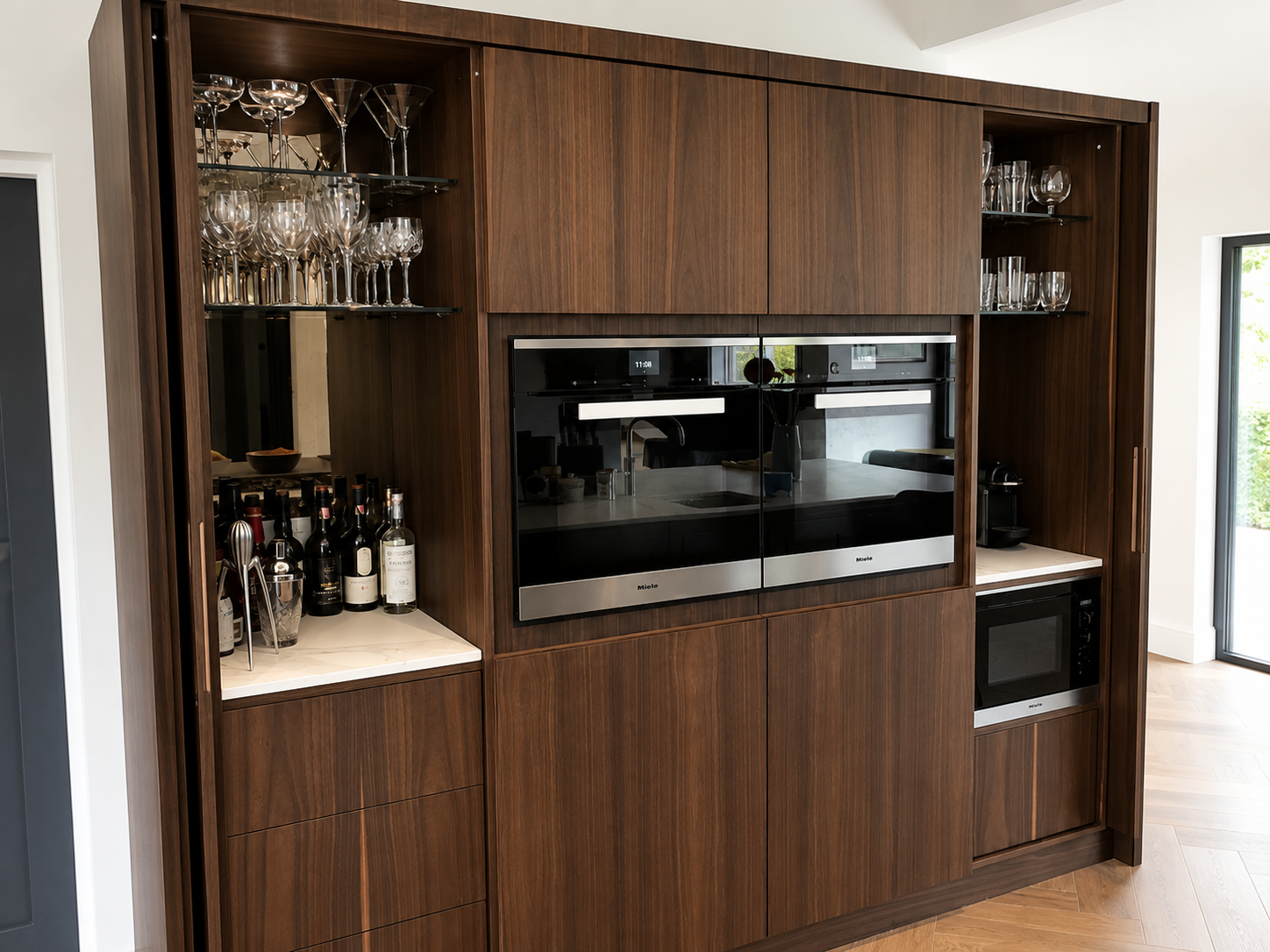
Fumed Eucalyptus veneer book matched across and around this oven and bar cabinet. Solid timber handles cut into the doors before veneer was applied.
Solid Timber and Veneer: Often Better Together
There's a common misconception that solid timber is somehow the "premium" choice and veneer is a cheaper substitute.
Good quality architectural veneer couldn't be further from that idea.
More importantly, it doesn't necessarily need to be a choice between one or the other.
Some of the best furniture and architectural joinery combines solid timber and natural veneer within the same piece, using each material where its particular characteristics make the most sense.
Solid timber is excellent for frames, mouldings, edges and components that need to be shaped or will receive regular wear. A solid timber lipping on the front of a veneered shelf, for example, gives a durable edge that can cope with years of use.
For large doors and panels, a veneered engineered substrate can offer much greater dimensional stability. Solid timber naturally expands and contracts as environmental conditions change. That's part of the material's character, but it needs to be allowed for in the construction.
A veneered panel gives us the beauty and individuality of genuine timber while remaining much more stable across a large surface.
A traditional framed door is a good example of how the two can work together: a carefully made solid timber frame surrounding a stable veneered centre panel.
It's not about deciding which material is "better".
It's about understanding where each material performs best.
There are even situations where veneer can be applied over a solid timber component. This allows us to retain the structural or machining properties we want from the solid material while using a particular veneer for its grain, figure or visual continuity.
That's one of the advantages of truly bespoke joinery.
We're able to choose the construction method around the piece rather than forcing the entire project into a single material system.
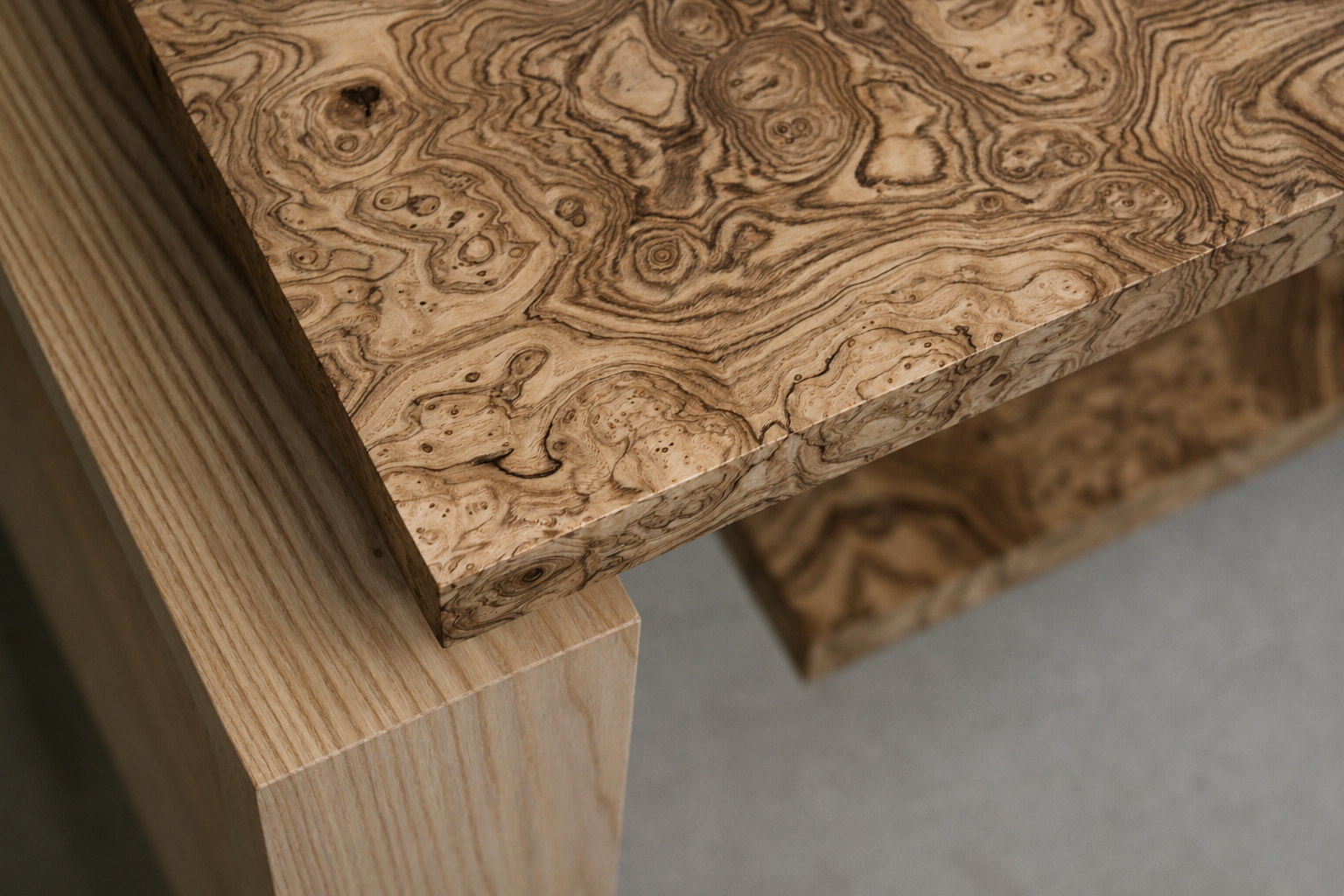
Solid Ash legs sitting below a Burr Olive Ash top. The veneer has been carefully laid out to wrap around the top and front edge.
Veneer Is About Composition
When we're looking at a bundle of veneer leaves, we're not simply asking whether the timber is attractive.
We're thinking about where each leaf will eventually appear.
Should the grain run vertically or horizontally?
Should adjacent doors read as one continuous surface?
Do we want symmetry?
Should the grain be calm and consistent, or should a particularly expressive section become a feature?
How will handles, shadow gaps and architectural lines interact with it?
A bank of four cabinet doors could technically be made from four unrelated pieces of the same timber.
But visually, it may feel completely different from four doors carefully laid out from consecutive veneer leaves.
The material hasn't changed.
The consideration has.
What Does Book Matching Mean?
One of the most recognisable veneer techniques is book matching.
Consecutive veneer leaves are opened like the pages of a book, creating a mirrored grain pattern.
With the right timber, the result can be dramatic.
But book matching isn't automatically the correct answer.
Slip matching places consecutive leaves alongside one another in the same orientation, creating a more consistent rhythm across a surface.
Other projects may call for intentionally quieter matching, particularly where the architecture or another material should remain the dominant feature.
There isn't a universally correct technique.
The important thing is that the decision is deliberate.
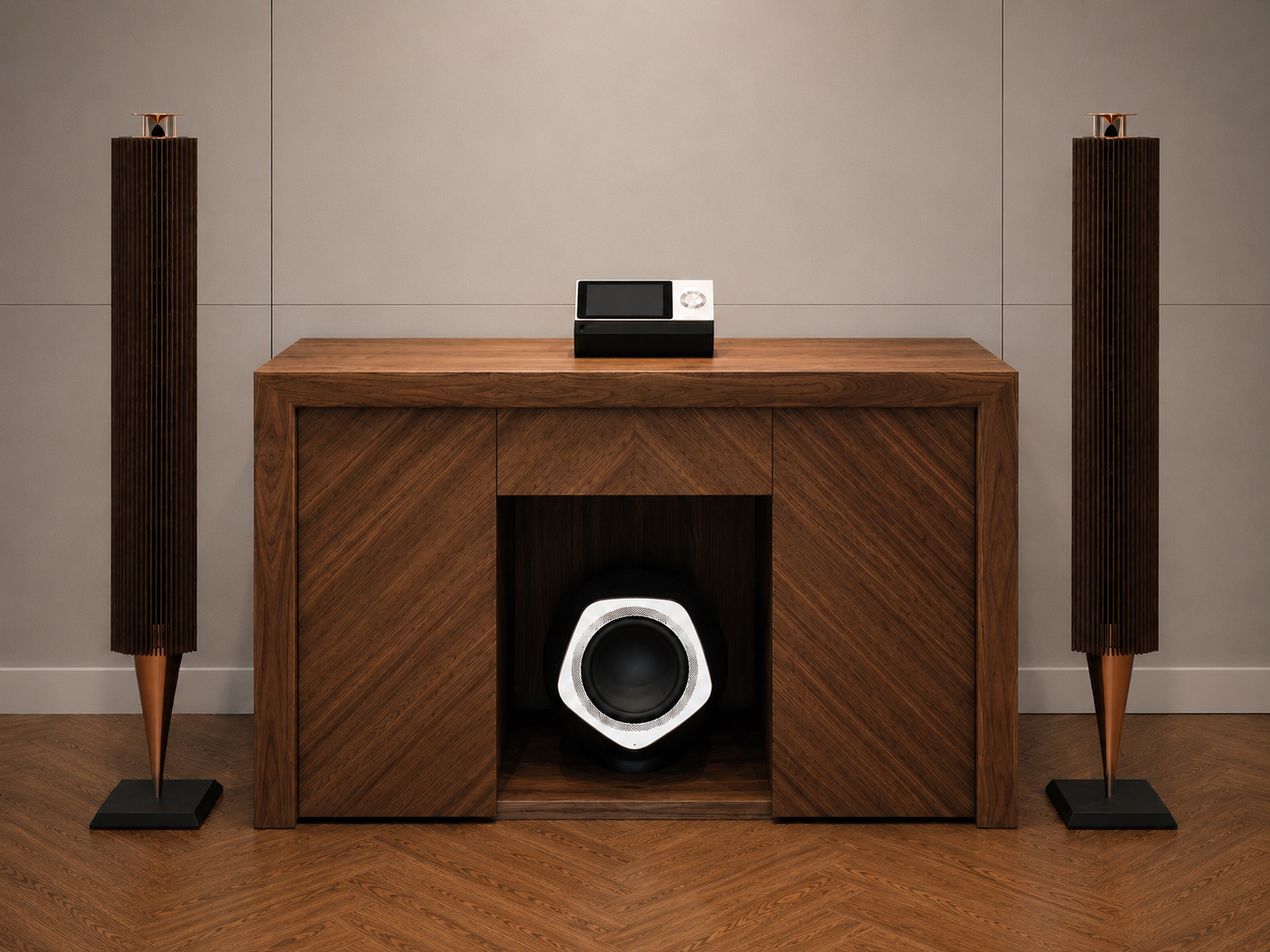
Bookmatched straight grain American black Walnut angled to 45deg for the doors and central drawer on this bespoke audio media cabinet.
Sometimes the Best Timber Is the Quietest
It's easy to be drawn towards the most dramatic piece of timber in the stack.
Burrs, ripples, strong cathedral grain and unusual figuring can be extraordinary.
But expressive timber needs somewhere to breathe.
If every surface in a room is competing for attention, none of them gets much.
Sometimes a restrained straight-grained veneer across a large fitted interior creates exactly the calmness the architecture needs.
Then perhaps a particularly beautiful burr appears on a smaller piece of bespoke furniture, an island or a pair of feature doors.
Good material selection isn't necessarily about choosing the most spectacular timber.
It's about choosing the right timber for the role it needs to play.
Grain Direction Changes How Furniture Feels
Grain direction can have a surprisingly strong effect on proportion.
Vertical grain can emphasise height.
Horizontal grain can make a long run of cabinetry feel broader and more continuous.
Following grain across adjacent drawer fronts can visually turn several separate components into one composition.
Sometimes we deliberately interrupt that continuity. Sometimes we preserve it carefully.
These decisions can look effortless once the furniture is installed, which is often the point.
The finished room shouldn't necessarily announce how much thought went into laying out the veneer.
It should simply feel right.
Natural Materials Need Variation
Choosing natural timber also means accepting that it is, well, natural.
Colour and grain variation aren't manufacturing defects. They're part of the material.
Timber can also change colour as it ages and is exposed to light. Some species become richer and warmer; others change more subtly.
For architects, interior designers and homeowners, samples are therefore useful — but they should be understood as a representation rather than a promise that every square metre will be identical.
Where natural timber forms an important part of a bespoke kitchen or fitted interior, understanding and working with that variation is part of achieving a considered result.
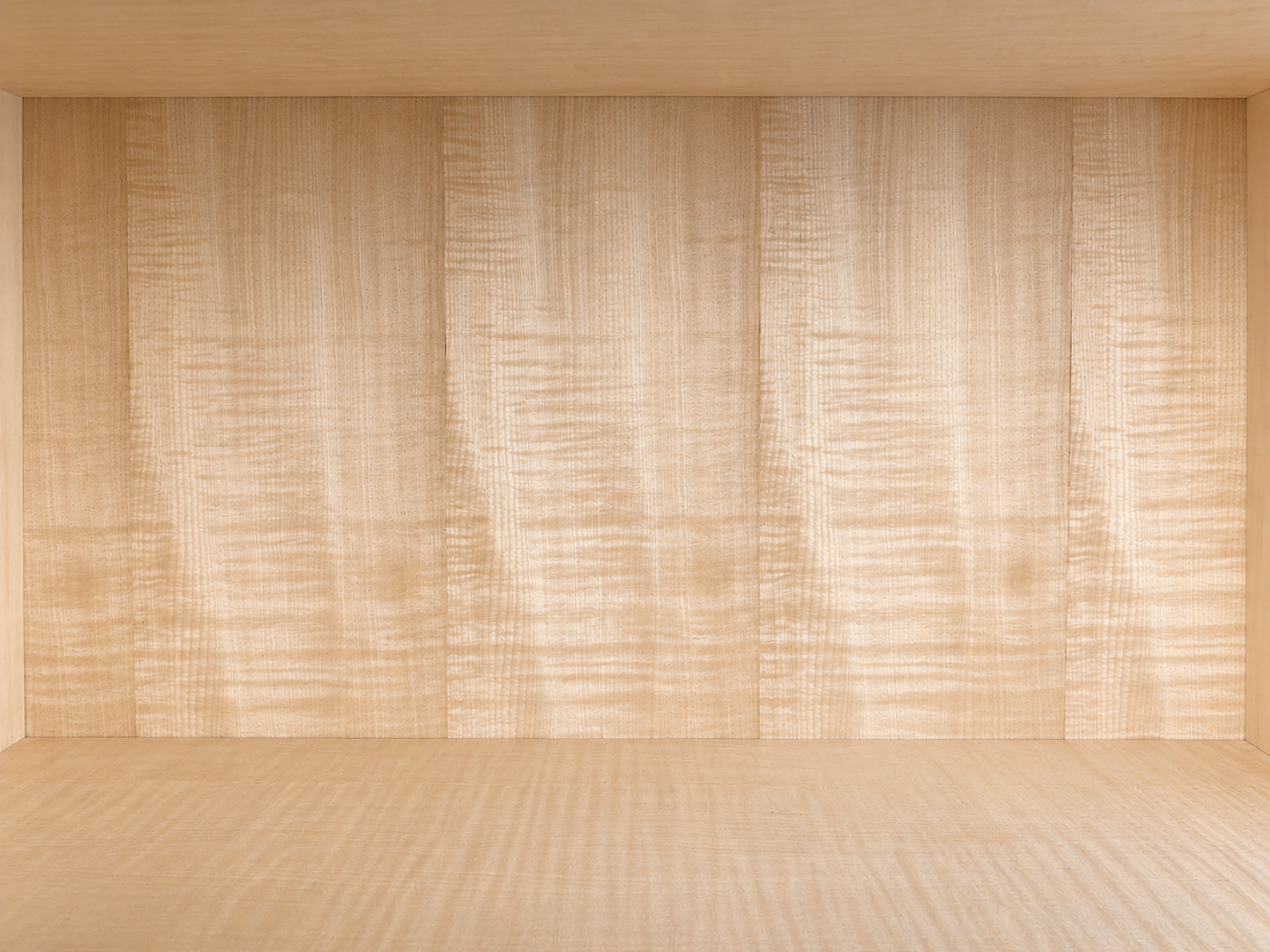
Slip Matched figured Sycamore veneer bookcase back.
Exceptional Timber Without Using a Whole Tree
Another advantage of veneer is just how efficiently it allows us to use beautiful timber.
A single exceptional log can produce consecutive veneer leaves capable of covering a considerable area of cabinetry, while retaining the character of genuine natural timber.
This becomes particularly relevant with rare, highly figured or expensive species.
Imagine covering a large bank of cabinetry in a beautiful burr, ripple or highly figured timber.
Producing the same visual result entirely from suitable solid boards could require an enormous quantity of exceptionally rare material — assuming enough matching timber could even be sourced.
The cost could quite quickly become eye-watering.
Veneer allows us to use those extraordinary timbers far more intelligently.
It isn't about making something look expensive for less.
It's about putting a valuable natural resource where it has the greatest visual impact and using solid timber where its physical properties provide the greatest benefit.
A veneered panel with carefully selected solid timber edges, frames or details can therefore be more practical, more stable, more economical in its use of material and every bit as luxurious as an entirely solid construction.
For us, that's not a compromise.
It's good cabinetmaking.
Timber in a Bespoke Kitchen
Natural timber can completely change the atmosphere of a kitchen.
A timber island can add warmth to an otherwise restrained painted kitchen.
Oak or ash cabinetry can sit beautifully alongside stone.
A small amount of figured veneer can create a focal point without overwhelming the room.
And timber doesn't have to mean a traditional kitchen.
Some of the most contemporary bespoke kitchens use natural materials precisely because they soften clean architectural lines.
The important part is deciding where timber belongs within the overall material palette.
Timber Beyond the Kitchen
The same thinking applies to custom cabinetry throughout the home.
Libraries.
Wardrobes.
Media units.
Home offices.
Window seats.
Bars.
Wall panelling.
Freestanding furniture.
Using related materials across several elements can create continuity through a home without making every room identical.
Perhaps the kitchen island introduces a particular oak.
The same timber then appears more subtly in a nearby fitted bookcase.
A freestanding table might use it differently again.
The connection doesn't need to be obvious.
Sometimes the best interiors reveal themselves gradually.
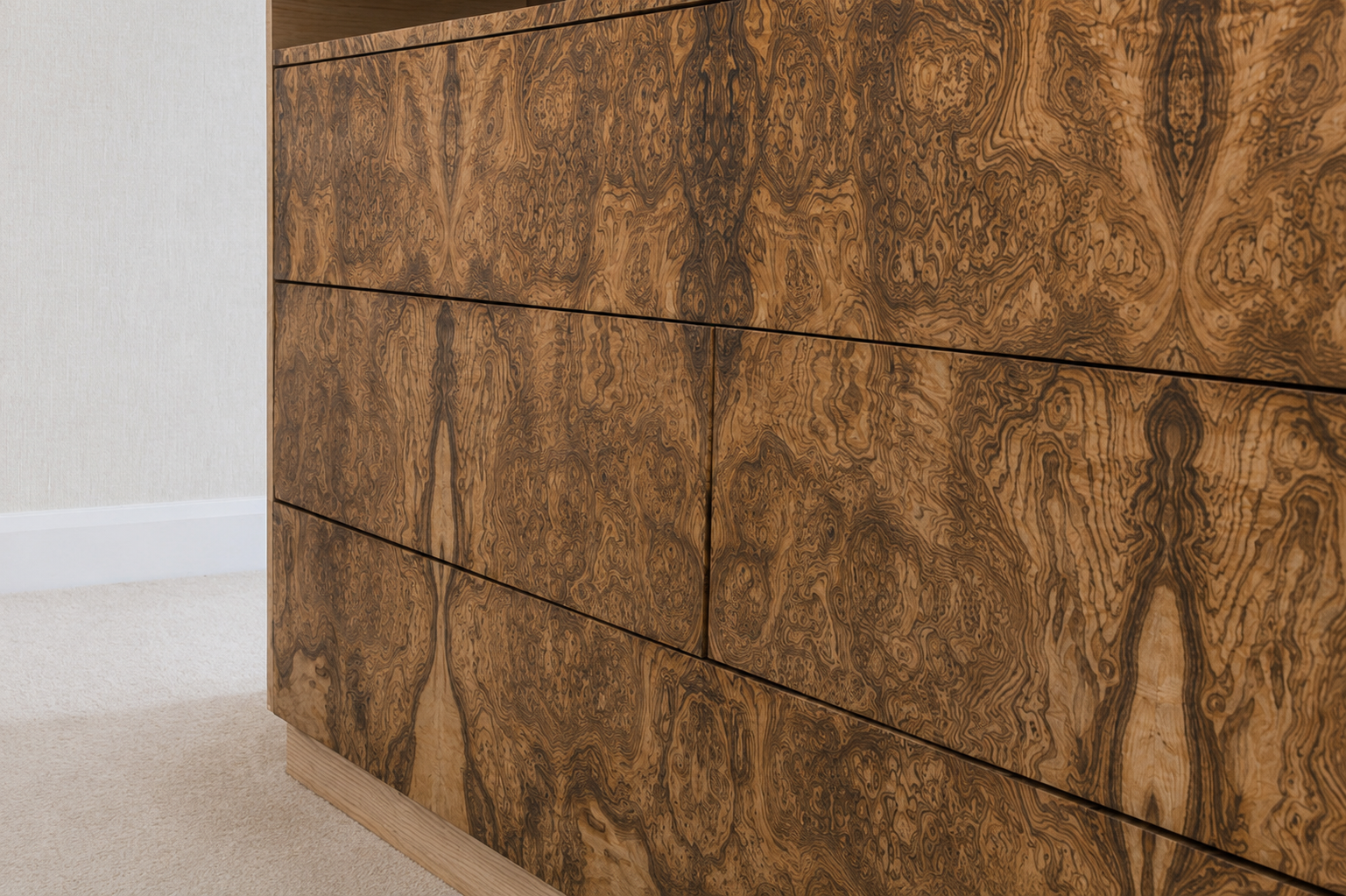
Bookmatched Burr Olive Ash veneer flowing through these push to open drawers.
Working With Architects and Interior Designers
Material-led projects are particularly well suited to collaboration.
An architect may establish the wider architectural language.
An interior designer may develop the palette of stone, textiles, flooring and colour.
Our job as cabinetmakers is to understand how the joinery contributes to that composition — and how those ideas translate into something that can actually be made.
That can mean discussing veneer orientation before elevations are finalised, reviewing samples alongside flooring or stone, suggesting a solid timber detail where an exposed veneered edge would be inappropriate, or identifying where an expressive material will have the greatest impact.
These conversations are easiest while the project is still flexible.
Craftsmanship Isn't Always About Complexity
There's a tendency to associate craftsmanship with complicated joints and visibly difficult details.
Those things certainly have their place.
But craftsmanship can also be quieter.
Selecting the right veneer leaf.
Following grain across a set of doors.
Adding solid timber where an edge needs to withstand years of use.
Choosing a stable veneered construction where seasonal movement could otherwise become an issue.
Knowing when a dramatic piece of timber will enhance a design — and when something quieter would be better.
Much of that thought disappears into the finished piece.
And that's often a sign that it's been done properly.
Planning a Bespoke Joinery Project?
Solum Bespoke designs and manufactures bespoke kitchens, custom cabinetry, fitted interiors and bespoke furniture in Wellington, New Zealand.
We work directly with homeowners and collaborate with architects, interior designers, builders and developers throughout Wellington, the Kapiti Coast, Wairarapa, Hawke's Bay and further afield for the right projects.
If you're considering natural timber, architectural veneer or simply want to explore what materials could work for your project, we'd be very happy to start the conversation.
You don't need to arrive with every detail resolved.
Bring us the drawings, the material palette, the timber sample — or simply the idea. Together, we can work out what belongs.
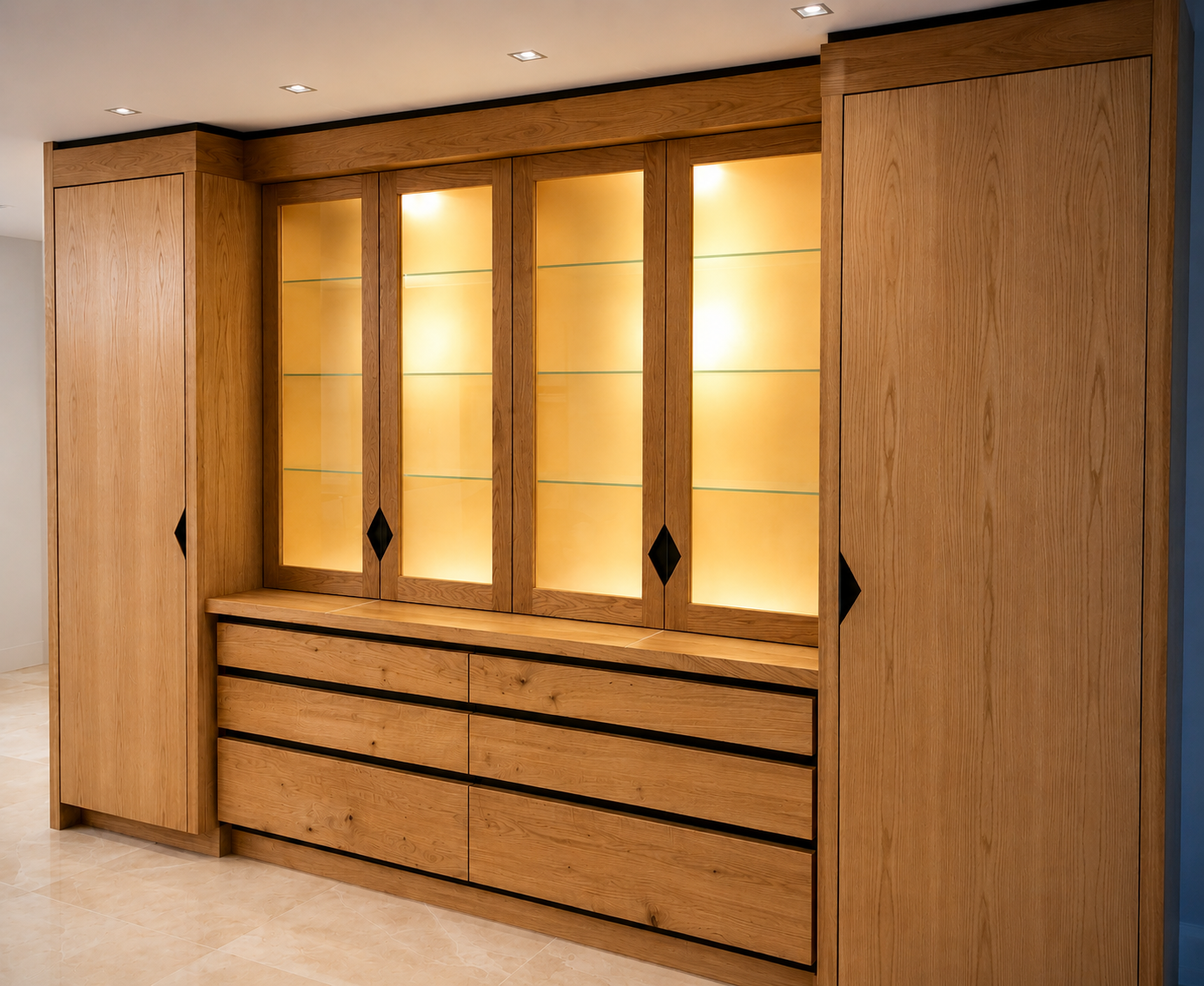
Solid Oak doors and Drawers meeting Veneered panels and tall larder doors.